
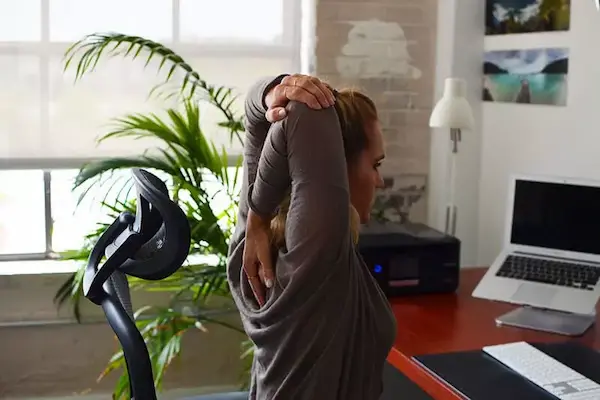
A desk friendly mini workout routine can turn a stiff, foggy afternoon into a calmer, more focused work block, without needing a gym mindset or a full outfit change.
Whether you work from home or in an office, these desk exercises are designed to stay moderate, respectful, and realistic, so you can move more often without disrupting your environment.
Why a desk friendly mini workout routine works when motivation feels low
Modern work rewards stillness, yet your body interprets long sitting as a gradual “shut down,” which is why small space fitness breaks often feel better than another cup of coffee.
Muscles and joints love gentle variety, so a short office workout that includes reaching, hinging, squatting to a comfortable depth, and easy core engagement can reduce tension without making you sweaty or breathless.
Energy improves when circulation increases, and circulation increases when you stand, shift weight, and breathe more fully, even if the movement looks “too easy” to count.
Focus tends to return when your eyes change distance and your spine changes shape, which means workday movement breaks can support both posture and productivity in the same five minutes.
Consistency becomes simpler when the plan is short, because you can repeat a mini routine daily without feeling like you must “train” or perform.
Common workday problems this mini routine targets
- Neck and shoulder tightness from screen time and stress.
- Mid-back stiffness from staying in one position too long.
- Hip and hamstring tension from hours of sitting.
- Wrist and forearm fatigue from mouse and keyboard use.
- Low energy and mental fog that builds after lunch.
- Restlessness that shows up as fidgeting, snacking, or doom-scrolling.
A gentle reminder that keeps this practical
Short movement sessions still count, because the goal is not to “crush a workout,” and the goal is to feel better often enough that your body stops dreading your chair.
Intensity rules for an office workout that stays work-appropriate
Moderate intensity is the sweet spot for small space fitness near a desk, because you want relief and alertness without heavy breathing that draws attention or creates self-consciousness.
Effort should feel like a steady wake-up, not like a sprint, since a micro-break works best when you can return to work without needing a shower or a long recovery.
Breathing is your built-in intensity meter, so if you cannot speak a full sentence comfortably, it is a sign to slow down, reduce range, or choose the seated version.
Form matters more than speed, because rushed movement often creates neck tension, noisy footsteps, and awkward twisting that can make you feel worse instead of better.
Use this quick intensity checklist
- You can breathe through your nose for parts of the routine, even if you occasionally switch to mouth breathing.
- You can speak in full sentences without gasping.
- Your shoulders stay down instead of creeping toward your ears.
- Your face stays relaxed, which is a surprisingly good sign you are not overdoing it.
- Your movements feel controlled, which keeps the routine quiet and respectful in shared spaces.
Pause immediately if any of these show up
- Dizziness, lightheadedness, or nausea that does not settle quickly with rest.
- Sharp pain, joint catching, or sudden strong discomfort.
- Chest pressure, fainting sensations, or unusual shortness of breath beyond normal exertion.
- Numbness, tingling, or radiating pain down an arm or leg.
Professional input is the right next step when concerning symptoms persist, because safety always matters more than finishing a timer.
Set up your small space fitness zone in under one minute
Space constraints can be an advantage, because a tiny “movement zone” reduces decision fatigue and makes the routine easier to repeat.
Noise control matters in offices and apartments, so soft steps and controlled transitions are part of the plan, not an afterthought.
Clothing can stay normal, because most of these desk exercises are designed to work in everyday workwear as long as you can move comfortably.
Quick setup steps
- Slide your chair back slightly so you have room to stand and hinge without bumping the desk.
- Place both feet flat and check the floor for slippery areas, cords, or rolling objects.
- Keep a bottle of water nearby, because hydration can reduce headaches and help you feel more awake.
- Choose a “quiet corner” where your steps land softly, especially if you share walls or floors.
- Set a timer for 5 to 10 minutes, because structure prevents the break from turning into distraction.
Chair and desk safety notes
- Use a chair that feels stable and does not roll unexpectedly, because sudden chair movement can create strain or falls.
- Rest hands lightly on the desk for balance when needed, because balance support can make movement safer without reducing effectiveness.
- Avoid pulling hard on the desk edge, because desks can shift, and shifting furniture can be noisy and unsafe.
Desk friendly mini workout routine: warm-up that feels subtle but effective
Warming up for one minute may sound unnecessary, yet it helps your joints and breathing “catch up,” which makes the rest of the routine smoother and more comfortable.
Gentle preparation also lowers the odds you feel dizzy when you stand quickly after sitting for a long time.
60-second warm-up near your desk
- Stand tall and inhale softly, then exhale longer while letting your shoulders drop, repeating this breath cycle three times.
- Roll your shoulders slowly backward for 20 seconds, keeping the movement small and controlled.
- March in place for 20 seconds with quiet feet, letting your arms swing naturally.
Optional seated warm-up if standing feels like too much right now
- Sit tall and do three slow breaths with a longer exhale.
- Lift one knee slightly and switch sides for 20 seconds, keeping your torso steady.
- Open and close your hands for 20 seconds to wake up wrists and forearms.
The movement menu: desk exercises that stay quiet and office-friendly
Choosing movements that respect your environment makes micro-breaks easier to repeat, because you stop worrying about noise, sweat, or drawing attention.
Range of motion is always optional, because the right range is the one your body accepts today without pinching or strain.
Upper-body reset moves
- Neck glide and reset: Gently pull your chin back as if making a “double chin,” hold for two seconds, and release.
- Shoulder blade squeeze: Draw shoulder blades back and down, hold for three seconds, and relax fully.
- Desk-supported chest opener: Place hands behind your back or on your hips, lift your chest slightly, and breathe calmly.
- Wall or desk push-up: Press away from a wall or desk edge with controlled elbows, keeping effort moderate.
- Seated “pull-down” arms: Reach overhead gently, then pull elbows down as if drawing curtains, moving slowly.
Spine and core support moves
- Seated torso rotation: Rotate gently to one side with an exhale, return to center, and repeat slowly.
- Standing ribcage side reach: Reach one arm overhead and lean slightly, keeping both feet grounded.
- Hand-to-knee press: Press your palm into the outside of the opposite knee and resist twisting, breathing steadily.
- Standing brace breath: Exhale and feel your waist gently firm like a belt tightening one notch, then inhale without losing posture.
Lower-body and circulation moves
- Sit-to-stand: Stand up from your chair slowly and sit back down with control, using the chair as a guide.
- Calf raises: Lift heels quietly, pause, and lower softly to avoid thumping.
- Mini hip hinge: Slide hips back with a long spine, then return upright, keeping the movement comfortable.
- Step-back tap: Tap one foot behind you and return, alternating sides with quiet feet.
- Seated knee extensions: Extend one leg, pause briefly, and lower slowly, switching sides.
Desk friendly mini workout routine: the 5-minute version
This 5-minute office workout is designed for days when your schedule is packed, your brain is tired, and you need a reset that feels quick and achievable.
Keep intensity moderate by moving smoothly, breathing steadily, and choosing smaller ranges if you feel tight or under-recovered.
How to run the 5-minute routine
- Work for 40 seconds and rest for 20 seconds, moving to the next exercise during the rest.
- Use the seated alternatives if you are on a call, in a shared space, or simply not in the mood to stand.
- Focus on quiet steps and controlled lowering, because control keeps everything more comfortable and discreet.
5-minute standing-and-seated circuit
- Minute 1: Quiet march in place with arm swings, keeping shoulders relaxed and breathing smooth.
- Minute 2: Desk-supported wall/desk push-ups, choosing an angle that feels easy enough to keep form clean.
- Minute 3: Sit-to-stand or seated knee extensions, moving slowly and pausing before momentum takes over.
- Minute 4: Standing ribcage side reach or seated side bend, using an exhale to soften into a gentle stretch.
- Minute 5: Hand-to-knee press (anti-rotation) with calm breathing, switching sides halfway through.
Seated-only swap list for camera-on or shared offices
- Swap marching for seated marching with smaller knee lifts and steadier posture.
- Swap push-ups for palm-to-palm isometric press, holding for 10 to 15 seconds, then relaxing briefly.
- Swap sit-to-stand for seated knee extensions or heel raises.
- Swap side reach for a gentle seated twist with a long exhale.
- Swap hand-to-knee press for shoulder blade squeezes with slow breathing.
Desk friendly mini workout routine: the 10-minute version
This 10-minute desk friendly mini workout routine adds a little more variety for your hips, upper back, and posture muscles, while still staying quiet and respectful of work environments.
Because fatigue can make movements sloppy, slower pacing is encouraged, especially during transitions where people tend to stomp, rush, or hold their breath.
How to run the 10-minute routine
- Work for 45 seconds and rest for 15 seconds if you like a steady rhythm, or use 40/20 if you prefer more breathing room.
- Choose standing moves for circulation, then use seated moves to calm the nervous system before returning to work.
- Stay at a “conversation pace,” because micro-breaks should refresh you rather than drain you.
10-minute circuit with clear roles for each minute
- Minute 1: Posture reset with three slow breaths, followed by shoulder rolls backward at a controlled pace.
- Minute 2: Quiet march with arm drive, emphasizing soft feet and tall posture.
- Minute 3: Desk-supported push-up or wall push-up, lowering slowly and pressing up smoothly.
- Minute 4: Mini hip hinge, sliding hips back and returning upright with an exhale.
- Minute 5: Sit-to-stand with a pause at the top, or seated knee extensions if standing is not ideal.
- Minute 6: Calf raises with a two-second pause at the top, lowering quietly like you are trying not to wake a sleeping pet.
- Minute 7: Step-back tap alternating sides, keeping the range small and the floor contact soft.
- Minute 8: Seated torso rotation, rotating gently on an exhale, returning to center with control.
- Minute 9: Hand-to-knee press (anti-rotation) with calm breathing, switching sides halfway through.
- Minute 10: Desk-supported chest opener and slow breathing, letting your shoulders settle down away from your ears.
Make it quieter without making it easier
- Slow the lowering phase of push-ups and sit-to-stand, because controlled descents reduce noise and increase muscle work.
- Add short pauses at the hardest point, because pauses raise intensity without needing speed.
- Reduce step size during taps and marches, because tiny steps can still elevate heart rate while lowering vibration.
- Use more isometrics on loud floors, because holds are almost silent and still effective.
Technique cues that prevent neck and low-back irritation
Desk work already asks a lot from your neck and low back, so a smart mini routine should leave those areas feeling supported rather than aggravated.
Alignment does not need to be rigid, yet a few gentle cues can prevent most discomfort that beginners experience during desk exercises.
Neck-friendly cues
- Keep your chin slightly tucked, because a forward head position can compress the neck and increase tension.
- Let shoulders drop down and back, because shrugged shoulders often signal stress rather than strength.
- Relax your jaw, because jaw tension often travels into neck stiffness without you noticing.
Low-back-friendly cues
- Think “ribs stacked over pelvis,” because excessive rib flare often creates low-back arching.
- Hinge from the hips rather than rounding the spine, because rounded hinges can irritate sensitive backs.
- Use a smaller range when unsure, because small, controlled movement builds confidence safely.
Wrist-friendly cues for keyboard-heavy days
- Choose wall push-ups or desk push-ups at a higher angle, because less bodyweight reduces wrist extension stress.
- Make fists for some movements if comfortable, because neutral wrists can feel better than flat palms.
- Shake hands out gently between moves, because small resets can reduce forearm tightness.
Scheduling workday movement breaks without disrupting meetings
Micro-breaks become habits when they are attached to something that already happens, because you stop relying on memory and start relying on routine.
Calendar reality matters, so the best schedule is the one that fits your workflow instead of fighting it.
Easy scheduling anchors that feel natural
- After your first coffee or tea, because the ritual already signals “start the day.”
- Before your first meeting, because your brain benefits from a short warm-up too.
- Right after sending a deliverable, because completion is a satisfying trigger for a reset.
- After lunch, because digestion and energy often improve with gentle movement.
- Before your last work block, because a reset can reduce end-of-day slumps.
Three micro-break scheduling systems you can try
- The hourly sip: Stand for 60 to 90 seconds every hour, doing calf raises and shoulder rolls while you hydrate.
- The meeting sandwich: Do two minutes of seated mobility before a meeting, then two minutes of standing movement after.
- The 2–2–2 rule: Every two hours, do two minutes of movement, and choose two exercises you enjoy so repetition stays pleasant.
How to stay respectful in shared work environments
- Choose quieter moves like calf raises, shoulder blade squeezes, and seated rotations when others are nearby.
- Avoid fast footwork if floors echo, because repetitive tapping can be distracting even when it is technically “low impact.”
- Keep breathing steady and quiet, because loud exhalations can feel intrusive in silent offices.
- Use smaller arm ranges if you are close to coworkers, because personal space matters as much as movement.
Desk friendly mini workout routine variations for different days
Different days require different doses, so having variations prevents the all-or-nothing cycle where you skip movement because the “perfect” routine feels too big.
Options also make this more inclusive, because comfort, mobility, clothing, and energy levels vary widely.
Low-energy version for stressful days
- Seated breathing reset for four slow breaths with longer exhales.
- Seated shoulder blade squeezes for 8 slow reps with full relaxation between reps.
- Seated knee extensions for 8 reps per side, moving slowly and pausing at the top.
- Seated torso rotation for 6 reps per side, keeping the range gentle.
- Standing calf raises for 10 slow reps, lowering softly and quietly.
Standing-focused version when you need circulation fast
- Quiet march for 60 seconds with strong arm swings.
- Step-back taps for 45 seconds with small range and soft feet.
- Mini hip hinge for 10 controlled reps.
- Wall or desk push-ups for 8 to 12 smooth reps.
- Chest opener with slow breathing for 30 to 45 seconds.
Seated-only version for calls, focus time, or privacy concerns
- Seated march for 45 seconds, staying tall through the spine.
- Palm-to-palm press for 15 seconds, followed by 10 seconds rest, repeated twice.
- Seated heel raises for 15 reps with a pause at the top.
- Hand-to-knee press for 15 seconds per side with calm breathing.
- Seated side bend for 5 reps per side, keeping both sit bones grounded.
Progress ideas that stay subtle and sustainable
Progress in an office workout context is often about frequency and comfort, because doing a little more often beats doing a lot rarely.
Upgrading quietly is the goal, so changes should make you feel better at your desk rather than more exhausted.
Quiet progression methods
- Add one extra minute to your routine twice per week, because small increases are easy to maintain.
- Slow your movements slightly, because time under tension builds strength without adding noise.
- Increase range of motion gently, because bigger ranges often become comfortable only after repetition.
- Upgrade your desk push-up angle gradually, because a slightly lower angle can increase challenge without changing the vibe.
- Track consistency, because the most reliable progress marker is simply “I did my breaks this week.”
Simple progress markers that do not require numbers
- Neck and shoulders feel looser by mid-afternoon.
- Lower back feels less stiff when standing up from the chair.
- Hands and wrists feel less tight after long typing sessions.
- Energy improves after movement breaks instead of crashing further.
- Focus returns faster after meetings or intense concentration blocks.
Frequently asked questions about desk exercises and micro-breaks
Will a 5–10 minute routine really make a difference?
Meaningful change often comes from repetition, so a short routine done most days can noticeably reduce stiffness and improve how you feel at your desk.
How often should workday movement breaks happen?
Many people feel best with a brief break every 60 to 90 minutes, yet even two breaks per day can be a strong start when life is busy.
What if I feel awkward doing an office workout at work?
Choosing seated exercises and subtle posture resets can give you the benefits without feeling like you are putting on a show, which is often the most respectful option in shared spaces.
What if I get dizzy when standing up to move?
Slower transitions, seated warm-ups, and longer exhales can help, while persistent or concerning dizziness deserves professional guidance for safety.
Can I do this in tight clothes or work shoes?
Sticking to smaller ranges, seated options, and quiet standing movements usually works well, while anything that feels restrictive is a sign to choose the gentler variation.
Closing thoughts for a calmer, more mobile workday
Working long hours does not require your body to feel locked up, because small space fitness can be woven into your day in ways that stay respectful and realistic.
When a desk friendly mini workout routine becomes a normal part of your schedule, you build comfort, consistency, and self-trust in a way that supports both health and productivity.
Notice: this content is independent and has no affiliation, sponsorship, or control over any workplaces, platforms, employers, or third parties mentioned.