
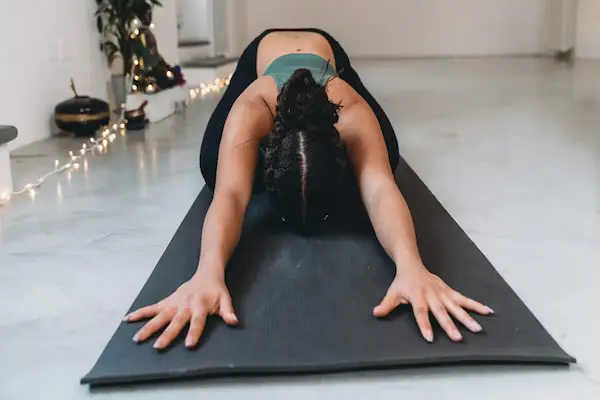
Some nights your mind feels loud even when the room is quiet, and you just want a simple, non-screen way to soften the day before sleep.
This slow routine gives you floor-friendly stretches, gentle holds, and steady breathing cues, while reminding you to stop if discomfort increases.
Why an evening stretching routine for relaxation can feel like a reset
When you move slowly on the floor and breathe with intention, your body often gets the message that it can shift from “doing” to “resting” without needing anything complicated.
Instead of chasing a big stretch, the goal is to invite your nervous system to downshift, because comfort and consistency usually matter more than intensity at bedtime.
Many people notice that a calm sequence helps them unwind at night by reducing fidgety tension in the hips, shoulders, and jaw, which are common “storage spots” for daily stress.
Because bedtime stretching is meant to prepare you for sleep, every position in this routine is designed to feel supported, unhurried, and easy to exit at any moment.
What “relaxing” should feel like in your body
Relaxing stretching tends to feel like mild to moderate sensation that fades as you breathe, rather than sharpness, pinching, tingling, or a sense that you must brace.
One helpful rule is that the stretch should feel more like an exhale and less like a challenge, so you finish calmer than you started.
If discomfort increases, if numbness appears, or if a joint feels unstable, treat that as a clear signal to reduce range, add support, or stop entirely.
Why the floor is your friend for winding down
On the floor, your body has built-in feedback and stability, which often makes a gentle flexibility routine feel safer and more soothing than standing stretches late at night.
With gravity doing less “pulling,” you can relax your muscles more easily, especially around the lower back, hips, and shoulders.
Since sleep likes predictability, returning to the same calm setup each evening can make the routine feel like a familiar doorway into rest.
Before you begin, create a calm and floor-friendly space
A small bit of preparation can make your routine feel like a ritual, which is valuable when you want a non-screen wind-down that doesn’t rely on willpower.
Choose a spot where you can lie down fully, stretch your arms out, and roll side to side without worrying about bumping furniture.
Keep the lighting soft, because bright light can make the body feel more alert even if your intentions are sleepy.
Wear something that does not pinch at your waist or shoulders, since tight clothing can quietly encourage shallow breathing.
Simple items that make stretching more comfortable
- Use a folded blanket under your head if your chin lifts toward the ceiling when you lie down.
- Place a pillow under your knees in resting positions if your lower back feels tight or “grippy.”
- Bring a yoga strap, scarf, or belt to support hamstring stretches without pulling aggressively.
- Keep a second blanket nearby so you can stay warm as your body temperature naturally drops before sleep.
- Set a timer with a gentle sound if you prefer not to watch the clock during holds.
A two-minute settling sequence to start
- Lower your shoulders away from your ears and let your hands rest open so your chest can soften.
- Allow your tongue to rest on the floor of your mouth so your jaw is not quietly clenching.
- Take one slower exhale than you think you need, because long exhales often feel like a signal of safety.
- Notice whether your ribs are lifting sharply, and aim for breathing that expands gently in all directions.
- Decide on a comfort rule, such as “no pain and no pushing,” so your body trusts what comes next.
The evening stretching routine for relaxation: a short floor sequence
This evening stretching routine for relaxation is designed to take about 12 to 18 minutes, depending on how long you choose to hold each position.
Every move is intentionally simple, because bedtime stretching should feel like easing into sleep rather than learning something new.
Breathing cues are included in each stretch, since your breath is the most direct, non-screen tool you have to unwind at night.
Move slowly between positions, and remember that you can always skip a stretch that does not feel good for your body today.
1) Constructive rest with slow breathing
Lie on your back with knees bent and feet on the floor, then let your knees relax toward each other so your hips feel supported.
Rest one hand on your belly and one hand on your chest, then breathe in gently through your nose and exhale as if fogging a mirror.
Stay here for 6 to 10 slow breaths, letting your shoulders melt downward as your exhale lengthens naturally.
- Hold time: about 60 to 90 seconds, or until your breathing feels quieter.
- Breathing cue: inhale softly for a comfortable count, then exhale slightly longer without forcing.
- Ease off if: your lower back arches sharply, and place a pillow under your knees for support.
2) Knee-to-chest hug, one side at a time
Keep your back on the floor as you draw one knee toward your chest, holding behind the thigh or over the shin without squeezing the kneecap.
Let the opposite leg stay bent with the foot grounded, because that often feels kinder to the lower back at bedtime.
Remain for 5 to 8 breaths, then switch sides with the same slow pace you want to carry into sleep.
- Hold time: 45 to 60 seconds per side.
- Breathing cue: exhale and imagine the back ribs spreading wider against the floor.
- Ease off if: you feel pinching in the hip crease, and hold behind the thigh instead of pulling the knee in.
3) Supine figure-four hip stretch
Cross your right ankle over your left thigh, flexing the right foot gently as if you are standing on it to protect the knee.
Thread your hands behind the left thigh and draw the legs toward you until you feel a steady stretch in the right hip and glute.
Stay for 6 to 10 breaths, and allow the right knee to move away from your chest only as far as it comfortably goes.
- Hold time: 60 to 90 seconds per side.
- Breathing cue: inhale into the sides of your waist, then exhale and soften the hip muscles.
- Ease off if: your knee feels strained, and keep the legs farther away while maintaining gentle foot flexion.
4) Hamstring support stretch with a strap
Lie on your back and loop a strap around the ball of one foot, then lift that leg toward the ceiling while keeping the other knee bent and grounded.
Instead of yanking, create the stretch by gently pressing the heel upward and letting the strap simply hold the position for you.
Breathe for 6 to 10 slow cycles, noticing how a small bend in the knee can turn strain into ease without reducing effectiveness.
- Hold time: 60 seconds per side.
- Breathing cue: exhale and let the back of the lifted thigh feel heavier toward the floor.
- Ease off if: you feel pulling behind the knee, and bend the knee slightly while keeping the ankle relaxed.
5) Supine twist to wring out the day
With both knees bent, let them fall slowly to one side while your shoulders stay relaxed on the floor, then turn your head only if it feels comfortable.
Place a pillow between or under your knees if your lower back feels sensitive, because supported twisting tends to be more soothing than deep twisting.
Take 6 to 10 breaths, imagining each exhale smoothing the front ribs and letting the belly soften naturally.
- Hold time: 60 to 90 seconds per side.
- Breathing cue: inhale into the back ribs, then exhale and let the knees sink a millimeter lower.
- Ease off if: your shoulder lifts or your back tightens, and bring the knees closer to center with support.
6) Child’s pose with pillow support
Come onto your knees and fold forward, placing a pillow or folded blanket under your chest if you want more comfort and less pressure in the hips.
Let your forehead rest on a soft surface so the neck can relax, and keep your arms wherever your shoulders feel most at ease.
Stay for 8 to 12 breaths, allowing the back body to widen as you breathe into the lower ribs.
- Hold time: 60 to 120 seconds.
- Breathing cue: exhale and imagine the back of your heart sinking toward the floor.
- Ease off if: your knees feel uncomfortable, and place a rolled blanket behind the knees or return to lying down.
7) Thread-the-needle shoulder release
From hands and knees, slide your right arm under your left arm, resting your right shoulder and the side of your head on the floor as your hips stay stacked above your knees.
Keep the left hand planted or reach it forward, choosing the version that lets your breath stay slow and steady.
Hold for 5 to 8 breaths, and notice whether relaxing your jaw makes your shoulders release more easily.
- Hold time: 45 to 60 seconds per side.
- Breathing cue: inhale wide across your upper back, then exhale and let the shoulder blade feel heavier.
- Ease off if: your neck feels compressed, and place a folded towel under your head for support.
8) Cat-cow for gentle spinal movement
Stay on hands and knees and move slowly between rounding and arching the spine, letting the movement follow the breath instead of forcing range.
Inhale as the chest opens slightly, then exhale as the belly draws inward and the back rounds comfortably.
Continue for 6 to 10 cycles, keeping the motion small and smooth so your body stays in “downshift” mode.
- Hold time: about 60 to 90 seconds total.
- Breathing cue: make the exhale longer than the inhale and let the movement soften with each round.
- Ease off if: your wrists feel strained, and come down to forearms or make fists for a neutral wrist angle.
9) Seated forward fold, supported and soft
Sit on a folded blanket with legs extended or slightly bent, then hinge forward from the hips until you feel a gentle stretch behind the thighs.
Rest your hands on your legs or a pillow, and allow your spine to be long rather than collapsed, since nighttime stretching should not feel like pulling.
Breathe for 6 to 10 cycles, and treat each exhale as permission to soften instead of a command to go farther.
- Hold time: 60 to 90 seconds.
- Breathing cue: inhale to lengthen the spine, then exhale to let the belly relax toward the thighs.
- Ease off if: your lower back feels sharp, and bend your knees more or fold over a pillow placed on your legs.
10) Legs up the wall, optional but deeply calming
Move your hips close to a wall and extend your legs upward, letting your arms rest out to the sides so your chest feels open and unforced.
Keep a slight bend in your knees if your hamstrings pull, and slide a folded blanket under your hips if you want a gentler angle.
Stay for 1 to 3 minutes, allowing the breath to become quiet while your body learns the feeling of stillness before bed.
- Hold time: 60 to 180 seconds.
- Breathing cue: exhale slowly and feel the weight of your legs sink into support rather than muscle effort.
- Ease off if: you feel tingling or pressure, and come out slowly by bending knees and rolling to one side.
How long to hold each stretch in bedtime stretching
Hold times matter because they keep your routine simple, predictable, and relaxing, which is exactly what you want when you are trying to unwind at night.
Shorter holds can feel refreshing, while slightly longer holds often feel more soothing, as long as you stay in a comfortable range.
Use the guide below as a starting point, then adjust based on how your body responds on a given evening.
| Stretch | Suggested hold | Breath focus |
|---|---|---|
| Constructive rest | 60–90 seconds | Longer exhale |
| Knee-to-chest | 45–60 seconds each | Back ribs soften |
| Figure-four | 60–90 seconds each | Relax hip on exhale |
| Hamstring with strap | 60 seconds each | Gentle heel reach |
| Supine twist | 60–90 seconds each | Wide rib expansion |
| Child’s pose | 60–120 seconds | Breath into low ribs |
| Thread-the-needle | 45–60 seconds each | Upper back widen |
| Cat-cow | 6–10 cycles | Move with breath |
| Supported forward fold | 60–90 seconds | Soften belly |
| Legs up the wall | 60–180 seconds | Quiet, steady breathing |
Two timing options depending on your energy
- Choose the “short” version by holding each position for about 45 seconds so the whole routine fits into roughly 10 minutes.
- Choose the “slow” version by holding each position for about 75 to 90 seconds so the routine becomes a longer, deeper exhale into sleep.
- Choose the “ultra-gentle” version by doing only the first five positions when your body feels tired or your mind feels overstimulated.
Breathing cues that help you unwind at night without screens
Your breath is the simplest bridge between your thoughts and your body, so using it well can turn a gentle flexibility routine into something genuinely calming.
Focus on comfort rather than perfect counting, because forcing the breath can quietly increase tension and defeat the purpose of bedtime stretching.
Three easy patterns to try during holds
- Try an inhale for 4 and an exhale for 6, letting the longer exhale feel like a slow dimmer switch for your nervous system.
- Practice “sighing out” through the mouth once every few breaths, because a relaxed sigh often releases hidden tension in the chest and throat.
- Use a soft nasal inhale with a whisper-quiet exhale, especially if you want the breath to feel private, gentle, and sleepy.
Body reminders that pair well with breathing
- Relax the space between your eyebrows as if you are smoothing a tiny crease that formed during the day.
- Soften your shoulders downward and imagine them becoming heavy, warm, and wide rather than lifted and narrow.
- Let your hands stay open because clenched hands can keep the whole system subtly alert.
- Unclench your glutes and allow your hips to feel supported, since gripping there often shows up when stress is high.
Gentle flexibility routine adjustments for common tight spots
Even a calming routine can feel awkward if you try to stretch the exact same way every night, because your body changes day to day.
Use these adjustments as permission to make the routine fit you, rather than forcing yourself to fit the routine.
If your lower back feels sensitive
- Keep both knees bent in supine positions so your spine stays supported and your breath stays easy.
- Place a pillow under the knees in constructive rest to reduce arching and help the belly relax.
- Use a pillow in twists so your knees do not fall too far and pull your lower back into strain.
If your hips feel tight after sitting
- Spend extra time in figure-four, but keep the stretch mild so the hip muscles learn softness rather than guarding.
- Support child’s pose with a pillow so the hips can relax without compression.
- Choose legs up the wall for a calming reset if the hip flexors feel tired from the day.
If your shoulders carry stress
- Repeat thread-the-needle twice on each side with shorter holds if your shoulders release better through repetition.
- Keep the head supported so the neck does not tense while you aim to relax the upper back.
- Use constructive rest longer and focus on widening the back ribs, which often softens the shoulders indirectly.
A simple seven-night plan to make the habit feel effortless
Habits stick more easily when the starting point is small, so this plan builds a calming routine without turning it into another task to “achieve.”
Consistency is the real secret, because repeating the same few cues teaches your body what bedtime feels like.
- On night one, do only constructive rest, knee-to-chest, and a supported twist, then stop while it still feels pleasant.
- On night two, add figure-four and keep the holds short so you finish wanting to return tomorrow.
- On night three, include the hamstring strap stretch and choose comfort over straight legs.
- On night four, add child’s pose and focus on breathing into the lower ribs like you are inflating a soft umbrella.
- On night five, introduce thread-the-needle and keep your neck supported so the stretch remains soothing.
- On night six, include cat-cow with small movements that feel like gentle rocking rather than deep bending.
- On night seven, try legs up the wall for one to two minutes and notice how stillness can feel like a reward.
Small cues that make the routine more likely to happen
- Place your blanket and pillow on the floor earlier in the evening so the space quietly invites you when you are tired.
- Choose a single “start signal,” such as brushing your teeth, so the routine has a consistent anchor.
- Keep the goal tiny, like “three stretches only,” because small goals remove resistance and build confidence.
- End the routine the same way each time, such as one long exhale in constructive rest, so your body recognizes the finish line.
Troubleshooting when stretching does not feel relaxing
Sometimes the intention is calm but the body is restless, and that is normal, especially during stressful seasons.
Adjusting your approach can make a big difference, because relaxation is often about environment, pacing, and support rather than flexibility.
Common issues and gentle fixes
- If your mind races, make your exhale longer and count quietly, because counting gives your attention a soft place to land.
- If the stretches feel too intense, reduce range by 30 percent and add support, because comfort builds trust faster than force.
- If you feel cold, use a blanket over your torso, because shivering and relaxation rarely coexist.
- If your body feels wired, shorten the routine and repeat the first two positions, because familiarity can be more settling than variety.
- If you feel sleepy halfway through, take that as success and end early, because the point is rest, not completion.
Safety notes for a calmer, safer evening practice
This routine is meant to be gentle, yet any movement practice should respect your personal health history and your body’s signals in real time.
Stop immediately if discomfort increases, if you feel sharp pain, if numbness appears, or if dizziness shows up, and consider speaking with a qualified professional if symptoms persist.
Move slowly when changing positions, especially near bedtime, because rushing can create lightheadedness or unnecessary muscle guarding.
Keep stretches mild if you are recovering from an injury, if you are pregnant, or if you have a medical condition that affects joints, nerves, or balance.
Quick self-check before each hold
- Ask whether the sensation feels like a stretch in muscle tissue rather than a pinch inside a joint.
- Check that you can breathe smoothly, because breath-holding is often the earliest sign of pushing too far.
- Notice whether the sensation decreases as you exhale, because relaxing should feel like softening over time.
- Choose the easiest version that still feels effective, because bedtime stretching works best when it feels safe.
FAQ about bedtime stretching and winding down
How late can I do this evening stretching routine for relaxation?
Most people can do it right before bed as long as the intensity stays gentle, because a slow pace and mild holds tend to calm rather than energize.
Should I stretch if I feel sore from workouts?
Light movement and supported holds can feel soothing when soreness is mild, yet strong pain is a sign to rest and avoid positions that increase discomfort.
What if I cannot do legs up the wall?
Skipping it is completely fine, because the routine still works well with constructive rest and a supported twist as your final calming positions.
Can this gentle flexibility routine improve sleep?
Many people find that consistent, comfortable stretching paired with longer exhales helps them unwind at night, although results vary and it is not a medical treatment.
How do I know I am not overstretching?
A good bedtime stretching sensation is mild and steady, while overstretching often feels sharp, shaky, numb, or worse with each breath.
Is it okay to do this without any yoga experience?
Because the movements are simple and floor-supported, beginners can usually follow comfortably by choosing smaller ranges and using pillows or blankets generously.
Important independence notice
Notice: this content is independent and does not have affiliation, sponsorship, or control by any institutions, platforms, or third parties mentioned.
Closing: make tonight feel a little softer
Give yourself permission to move slowly, to keep the stretches easy, and to treat every exhale like a gentle cue that the day is complete.
With a calm setup, supportive holds, and a steady breath, this evening routine can become a comforting, non-screen signal that it is safe to rest.